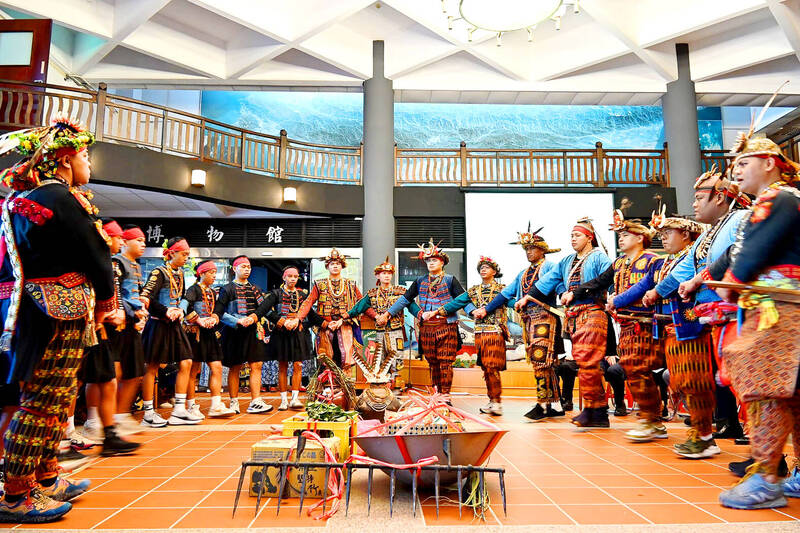
By Rachel Lin / Staff reporterAcademia Sinica’s Institute of Ethnology and the Kaviyangan community in Pingtung County’s Taiwu Township (泰武) yesterday formalized a cultural alliance through a traditional Paiwan masanvetjek ceremony, pledging to regard one another as siblings (vetjek).請繼續往下閱讀...The Tjerelai family of the Kaviyangan community also donated 36 reels of audio recordings to the institute’s collection. The recordings document key moments in the community’s history and serve as an important resource for preserving and passing on its cultural heritage.The connection between the Institute of Ethnology and Kaviyangan Village dates back to their shared effort to safeguard a national treasure — the “mulitan” ancestral pillar, Academia Sinica President Chen Chien-jen (陳建仁) said.Since the joint curation of the “Returning Home: Recalling kaviyangan’s Records of Art” exhibition in 2020, the two sides accumulated six years of collaboration in holding physical and online exhibitions, building trust and deep fellowship, he said.Yesterday’s new alliance was formed according to Paiwan tradition, and it marks a major milestone in returning knowledge to the sovereignty of the tribe.The alliance ceremony was led by the Zingrur family, traditional leaders of the Jiaping people, and they entered the venue while tribe members shouted, intoned ancient chants and fired guns, to perform an emayam (blessing and verification of gifts) ritual.The Zingrur family bestowed upon the Institute of Ethnology the house name Vavulengan, implying the pinnacle of academic prestige, as well as symbolizing the peaceful dwelling of the mulitan ancestral spirit pillar within the vavulengan family house.Following the ritual, an official announcement of the alliance was made to the ancestral spirits and the tribe.After the alliance was formed, the Jiaping donated 36 volumes of mamazangiljan ti ljaljangalan a lja zingrur oral history recordings to the institute.The collection was personally recorded in the 2000s by Chou Lin Yi-chih (周林義治, 1923 to 2017), a younger brother of the tribe’s 17th-generation leader.The contents cover the tribe’s founding history, shifts in traditional rituals, and historical experiences of traditional leaders in exercising regional diplomacy, which serve as crucial oral history and cultural memory for the Jiaping Tribe.Institute of Ethnology director Jou Yuh-huey (周玉慧) said once the oral recordings enter the public cultural preservation system, the cultural vitality of indigenous people in contemporary society can be sustained through research, archiving and reinterpretation.Chou Lin’s granson Chou Cheng-chun (周政君) said that the voice recordings left behind by his grandfather serve as an important memory repository for future generations to understand the history and culture of the Jiaping Tribe.They also bear the strength of the tribe as it faces the changing of times and safeguards its cultural autonomy, he said.The event concluded with the Paiwan traditions of zemiyan (a circle dance) and papukizing (a ceremony of becoming family).The Jiaping Tribe also presented a large wooden kadang (spoon), symbolizing sharing meals from the same hearth, and both sides expressed commitment to maintaining their sibling bond and continuing to promote cultural preservation, knowledge inheritance and tribe-centered cultural revitalization.新聞來源:TAIPEI TIMES
评论 (0)