
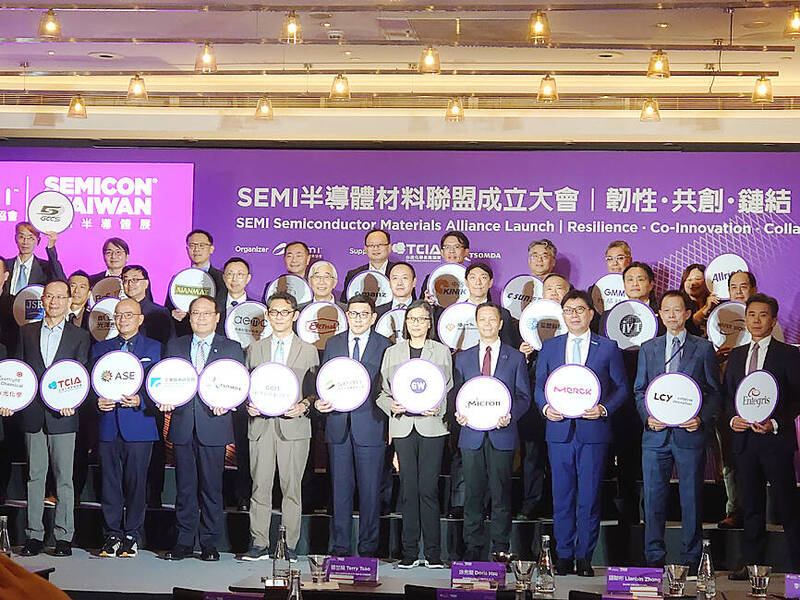
SPECIALTY SUPPLIES: Taiwan is ushering in a major shift in industrial upgrades and a local alliance will reinforce supply chain resilience, SEMI president Terry Tsao saidBy Lisa Wang / Staff reporter請繼續往下閱讀...SEMI Taiwan launched a semiconductor materials alliance yesterday to fortify industry resilience, capitalizing on surging domestic demand fueled by advanced nodes and next-generation packaging.Taiwan has been the world’s largest semiconductor materials consumer for 16 years in a row, the industry association said.Taiwan purchased about US$21.7 billion of semiconductor materials last year, driven by artificial intelligence (AI)-related demand, SEMI data showed.The spending accounted for 30 percent of global semiconductor materials consumption, totaling US$73.2 billion, the data showed.“Demand for specialty gases, chemicals and key raw materials are rising in Taiwan, fueled by the technology advancements to 2-nanometer and advanced packaging technologies,” SEMI Taiwan president Terry Tsao (曹世綸) told a news conference in Taipei.“Taiwan is ushering in a pivotal shift in industrial upgrades, given its advantages in industrial clusters, customer proximity and customer agility,” Tsao said.With the expansion of Taiwan’s semiconductor materials market, establishing a localized alliance is a timely and strategic move to reinforce supply chain resilience and mitigate the risk of raw material disruptions in domestic manufacturing, he said.Driven by skyrocketing demand for AI applications, the semiconductor supply chain is facing unprecedented capacity constraints, particularly in critical components such as substrates, ASE Technology Holding Co (日月光投控) vice president Hiro Huang (黃義從) told the news conference.“For ASE, [customer] demand has outpaced supply. Overall, we can only satisfy less than half of customers’ demand,” Huang said.The market opportunity is immense, but the industry is grappling with a staggering supply-demand gap, he said.The massive gap is a powerful catalyst for local suppliers to enter the market, he said.About 60 to 70 percent of raw materials used by ASE come from local supplies, he said.ASE began sourcing T-glass from Taiwan Glass Industry Corp (台灣玻璃) two years ago, due to severe supply shortages from global suppliers, Huang said.That has not happened in the past four decades, indicating that Taiwan-based suppliers have a chance to play a “supplementary role” to their global rivals, he said.T-glass is a high-performance, ultra-thin specialty fiberglass cloth used as a foundational reinforcement material in advanced semiconductor IC substrates, such as ABF and BT carriers, and high-end printed circuit boards to prevent chips from warping under extreme operational heat.“As semiconductor technologies continue to advance, the importance of materials is rising rapidly and continued innovation across the industry depends on close collaboration among partners throughout the value chain,” GlobalWafers Co (環球晶圓) chairwoman Doris Hsu (徐秀蘭) said.Through the SEMI Taiwan Materials Alliance, GlobalWafers looks forward to deepening collaborations to improve supply resilience for critical raw materials and semiconductor materials, Hsu said.More than 30 firms — from wafer suppliers and chip packaging service providers to suppliers of specialty chemicals and equipment — are members of the SEMI Taiwan Materials Alliance, including ASE, GlobalWafers, LCY Chemical Corp (李長榮化工) and Advanced Echem Materials Co (新應材), SEMI said.新聞來源:TAIPEI TIMES
评论 (0)